
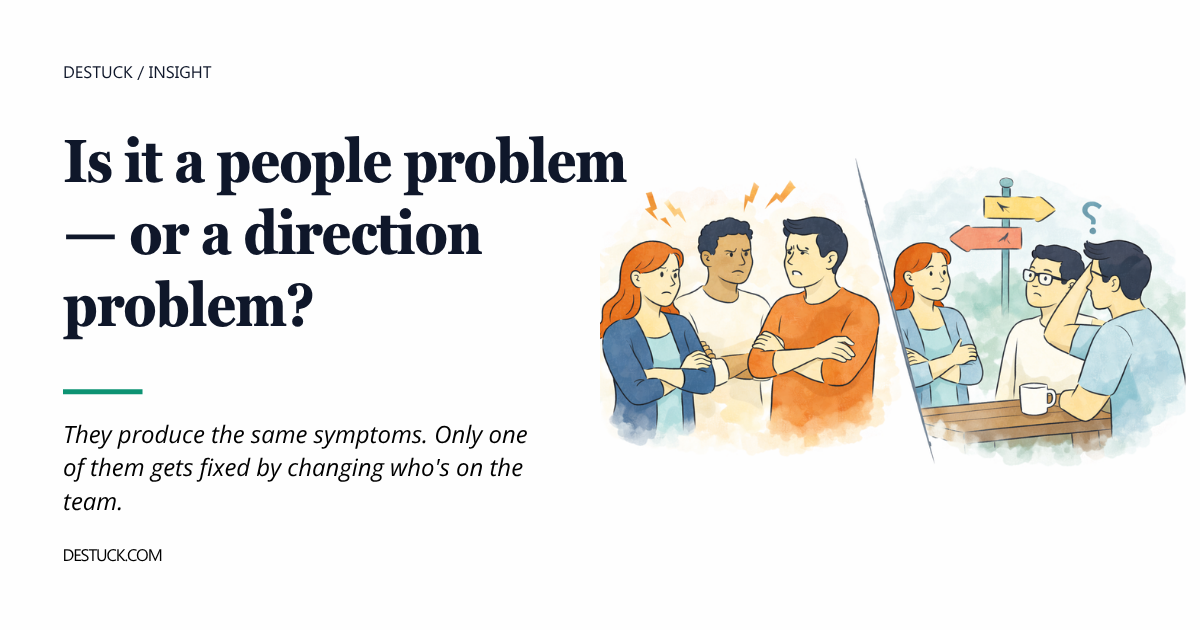
Is it a people problem — or a direction problem?
They produce the same symptoms. Only one of them gets fixed by changing who's on the team.
There's a conclusion most managers reach quickly when the team isn't delivering. Someone isn't pulling their weight. Someone doesn't get it. The talent bar is wrong, and it needs to be fixed.
It's a clean explanation. It's also, more often than people realize, incorrect.
What a direction problem looks like from the outside
The symptoms are: missed commitments, work going in the wrong order, effort that doesn't translate into output, low initiative, vague answers when you ask what someone is working on. The team seems capable on paper but inconsistent in practice.
These are the same symptoms a people problem produces. That's the trap.
What makes them different isn't what you see — it's what's causing it. In a direction problem, the team doesn't have a shared, working answer to two questions: what are we actually trying to do right now, and what should I be prioritizing today because of that? Not the mission statement. Not the Q3 OKRs. The actual operating answer that tells someone how to make a decision when two priorities compete. When that answer is missing or unstable, people fill the gap with their own interpretation. And because everyone fills it differently, the result looks like misalignment, low initiative, or variable output — even when the people are perfectly capable.
Not sure if your team has a Direction problem or something else?
The Destuck diagnostic measures Direction alongside eleven other structural dimensions — so you can see exactly where the constraint is.
Take the diagnosticThe attribution error
The reason managers reach for the people explanation first is that it's more visible. You can see that someone missed a deadline. You can't see that they were working toward a priority that made complete sense given the signals they'd received.
Chris Argyris spent decades studying how people behave inside organizations when something isn't working. One of his central observations was that when structural conditions are ambiguous or dysfunctional, people don't surface the problem — they adapt to it. They develop workarounds. They stop raising the contradiction between what's officially true and what they experience as true. From the outside, this adaptation looks like disengagement, low initiative, or poor judgment. The person seems like the problem. The structural condition that produced the behavior stays invisible.
Direction problems work exactly this way. The team has quietly adapted to not having a clear operating answer. The workarounds become habit. And then the manager looks at the results and sees people who aren't performing.
The five signals it's Direction, not people
These aren't diagnostic criteria — they're patterns worth recognizing.
The team can't consistently answer "what are we working toward this week" without hedging or consulting multiple sources. Different members would give meaningfully different answers to the same question about current priorities. Effort concentrates on visible activity rather than highest-impact work. Decisions that should be fast get escalated or delayed because the deciding principle isn't clear. When something slips, the post-mortem focuses on execution details rather than whether the right thing was being worked on at all.
None of these require underperforming people. They require an absent or unstable operating direction.
Why swapping people doesn't fix it
New people inherit the same conditions. If direction isn't clear, they'll develop their own interpretation of priorities — same as the last person did. They may perform better initially, because new hires often create their own clarity through sheer onboarding energy. But six months in, if the structural condition hasn't changed, you'll see the same symptoms.
The team takes on whoever you hire. The structural conditions shape what those people produce. This is why the same pattern recurs across different team compositions, and why managers who have made several hires into a persistent problem often end up questioning their own judgment — when the issue was never the judgment, it was the condition they kept hiring into.
How to tell the difference
One practical test: ask three members of your team, independently, to describe the team's top two priorities right now and how this week's work connects to them. If the answers are consistent and specific, the issue probably isn't Direction. If they diverge — or if they're accurate at the level of goals but can't connect to this week's actual work — that's the signal.
A people problem survives this test. A Direction problem doesn't. You'll see the gap immediately.
What to do when it's Direction
This isn't about setting better goals or running a strategy session. It's about creating a working answer to the daily operating question: given everything we're trying to do, what should someone prioritize when the choices compete?
Three moves that matter structurally: make the current priority explicit and narrow — one thing that, if done well this week, matters most. Create a decision rule for trade-offs so people don't have to escalate every conflict. And make the priority visible enough that it doesn't require a meeting to confirm. None of this requires new people. It requires the clarity that lets existing people perform.
Destuck measures Direction as one of twelve structural dimensions — and it's among the most commonly constrained pillars in teams that are underdelivering. The diagnostic shows you where the gap actually is.
Take the diagnosticNot sure what to write? Grab a ready-to-use post.