
Off-sites and retreats don't fix teams. Here's what does.
The energy from a great off-site lasts about two weeks. The structural problems that made you need one in the first place? Those are still there on Monday.
The Monday after the mountain
I've watched this play out so many times it's almost become a genre. The company books a lodge, a vineyard, a conference center with too many whiteboards. Two days of honest conversations, vulnerability exercises, a ropes course or an escape room. People laugh together. Someone cries a little. The CEO gives a speech about trust. Everyone drives home feeling genuinely closer.
Monday morning: the same inbox. The same unclear priorities. The same meeting where three people talk past each other about the roadmap. Within two weeks — sometimes less — the retreat is a memory. A nice one, but a memory.
And here's the part that nobody says out loud: the retreat might have actually made things harder to fix. Because now there's a story that something was done. Leadership invested time and money. The team had its moment. So when the same dysfunctions resurface three weeks later, the unspoken conclusion is: "We tried. This is just how the team is."
That conclusion is wrong. But it's understandable.
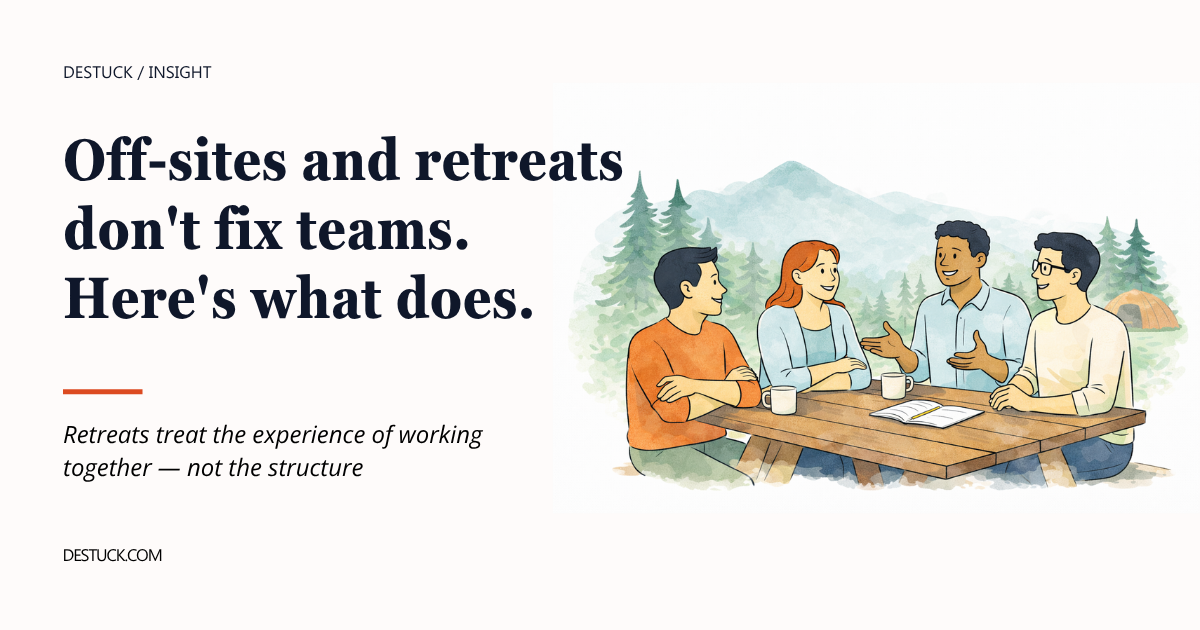
Retreats treat the experience, not the structure
There's nothing wrong with retreats in principle. Getting people out of the office, removing the usual pressures, giving everyone space to talk — all of that has value. Real conversations happen. People see sides of each other they don't see in sprint reviews.
But here's the distinction that changes everything: retreats improve how the team feels about working together. They don't change how the team actually works together. And those are very different things.
Feelings are real, but they're not structural. Trust built over a dinner doesn't survive a system where nobody knows who owns what. Connection forged on a hike doesn't hold when three conflicting priorities compete for the same week. The warm glow of vulnerability doesn't fix the fact that decisions get relitigated in every meeting because there's no shared framework for how decisions get made.
Harvard's J. Richard Hackman spent decades studying what makes teams effective. His conclusion was blunt: it's not the relationships between people that determine performance — it's the enabling conditions around them. Direction, structure, resources, norms. Get those right and even teams with interpersonal friction perform well. Get those wrong and even teams that genuinely like each other will struggle.
Think the problem might be structural?
The Destuck diagnostic maps your team across 12 structural dimensions — in about 5 minutes.
Take the diagnosticThe illusion of having addressed it
This is the part that's genuinely counterintuitive: a retreat can extend a structural problem's lifespan by months.
Here's the mechanism. Before the retreat, there's a vague but persistent sense that something is wrong. Maybe it's been six months of the same complaints in retrospectives, or a quarter of missed deliverables. That discomfort is actually useful — it creates pressure to investigate, to diagnose, to change something real.
The retreat relieves that pressure without removing the cause. It gives everyone — the team, the manager, leadership — a story about action having been taken. "We invested in the team." "We had really honest conversations." "People feel better about things."
And for a couple of weeks, people genuinely do feel better. So the urgency to look deeper evaporates. The structural problem — unclear direction, broken systems, an environment that discourages honest disagreement — gets another three to six months of quiet survival.
Chris Argyris, the organizational theorist, had a term for this kind of pattern. He called it a "defensive routine" — an organizational habit that protects people from uncomfortable truths while simultaneously preventing those truths from being addressed. A retreat can function exactly this way: it defends the organization from the discomfort of structural diagnosis by substituting an emotional experience.
What actually moves the needle
If retreats treat the experience and not the structure, then the question becomes: what treats the structure?
I've seen four things that consistently produce lasting change in teams — and none of them require a mountain lodge.
First: diagnose before you intervene. This sounds obvious, but almost nobody does it. Most managers jump from symptom to solution without a structural diagnosis in between. They see low morale and plan a retreat. They see missed deadlines and add process. They see conflict and send people to a communication workshop. The intervention addresses whatever the most visible symptom is, rather than the underlying condition that produced the symptom in the first place.
Second: fix one system, not "the culture." Culture is the aggregate result of how a team operates day to day. You can't fix it directly — you can only fix the specific structural conditions that shape it. So instead of "improve our culture," pick one broken system: the way decisions get made, the way work gets handed off, the way priorities get communicated. Fix that one system well. Culture shifts follow.
Third: make the invisible visible. Most structural problems persist because they're hard to see. The team doesn't have a shared language for the thing that's off. They feel it individually — the frustration, the friction, the sense that things should work better than they do — but they can't name it collectively. Giving the problem a name, a shape, a shared vocabulary changes the dynamic entirely. Suddenly the pattern isn't just something you endure. It's something you can point to and address.
Fourth: change the conditions, not the people. Google's Project Aristotle study found that who was on a team mattered far less than how the team was structured. The same people, in different structural conditions, produce radically different results. When a team is underperforming, the instinct is to look at the individuals. The evidence says: look at the conditions around them first.
The retreat isn't the mistake — the sequence is
I want to be clear: I'm not against retreats. I've been on great ones. The mistake isn't the retreat itself — it's doing the retreat instead of the diagnosis, rather than after it.
A retreat after a structural diagnosis is a celebration. The team knows what was broken, they've seen it fixed, and they're coming together to reset with shared clarity about how they operate. That's powerful.
A retreat before a structural diagnosis is a sedative. It soothes the symptoms long enough for everyone to forget they were supposed to investigate the cause.
If your team has been stuck for a while — the same problems, the same retrospective complaints, the same feeling that things should be working better than they are — the answer probably isn't a vineyard and a ropes course. The answer is finding out what's actually wrong. Everything else comes after that.
The Destuck diagnostic maps twelve structural dimensions of how your team actually works — so you can see what's constraining delivery before booking the next off-site.
Take the diagnosticNot sure what to write? Grab a ready-to-use post.