
Why smart teams still fail
Strong expertise does not automatically create strong results.
There's a team I keep thinking about. Not a specific team — more of an archetype. You've probably managed one, or been on one, or watched one from across the hall.
On paper, everything looks right. The people are experienced. The individual track records are strong. There's relevant expertise across the key areas. Leadership invested in hiring well, and it shows — the resumes in the room are impressive.
Then the quarter ends, and the results don't match the talent. Deadlines slipped. A key project is behind where it should be. Meetings run long and produce little. Everyone is busy — genuinely busy — but the output doesn't reflect it. And the question that hangs in the air is the one nobody quite knows how to answer: if the people are this good, why isn't it working?
The usual response to this question is to look for someone or something to blame.
Maybe it's a motivation problem — so the fix is a push, a pep talk, or more pressure. Maybe it's a people problem — so the fix is a performance conversation or a replacement hire. Maybe it's process — so the fix is a new tool, a new framework, or more meetings. Maybe it's discipline — so the fix is tighter supervision and shorter deadlines.
Each of these feels logical in the moment. And each of them occasionally helps — for a while.
But here's the pattern I keep seeing: when the wrong fix is applied to the right problem, it doesn't just fail to help. It makes things worse. The team starts to feel like improvement isn't possible. Each failed intervention erodes a little more trust — not in the leader specifically, but in the idea that anything will actually change.
I think the reason these fixes keep missing is that they're aimed at the wrong level.
When we say a team is "smart," we usually mean the individuals inside it have strong expertise. They're knowledgeable, technically capable, often impressive in their domain. And the assumption — rarely stated but always present — is that smart individuals should produce smart results.
But that's not how teams work.
The moment people need to coordinate — share information, make joint decisions, sustain momentum together — other conditions start mattering just as much as individual capability. Clarity of direction. Psychological safety. Whether the systems help or get in the way. Whether people can actually convert decisions into action, or whether everything stalls in consensus and discussion. A team is not the sum of its members' capabilities. It's the product of the conditions those members work inside.
This distinction sounds abstract until you see it play out.
I've watched teams where every person was individually strong, but the direction was unclear. Not dramatically unclear — nobody was confused about the company's mission. But the day-to-day priorities shifted often enough that people were making independent judgment calls about what mattered most. They didn't all make the same call. The work got done, but it didn't add up. Smart people, pulling in slightly different directions, producing fragmented output.
I've watched teams where the expertise was deep but the environment was thin. People didn't feel safe pushing back on bad ideas, so bad ideas survived longer than they should have. Decisions were made slowly, not because people were indecisive, but because disagreement had no safe channel. The talent was there. The conditions around it quietly prevented it from doing its job.
And I've watched teams that had both clarity and safety but lacked what I'd call force — the ability to convert a decision into movement. They could discuss anything beautifully. They could analyze a situation with real sophistication. But the distance between "we've decided" and "we've done it" was enormous, and nobody could explain why.
Wondering which structural conditions are limiting your team?
The Destuck diagnostic maps all 12 dimensions — so you can see what's actually driving what you're seeing on the surface.
Take the diagnostic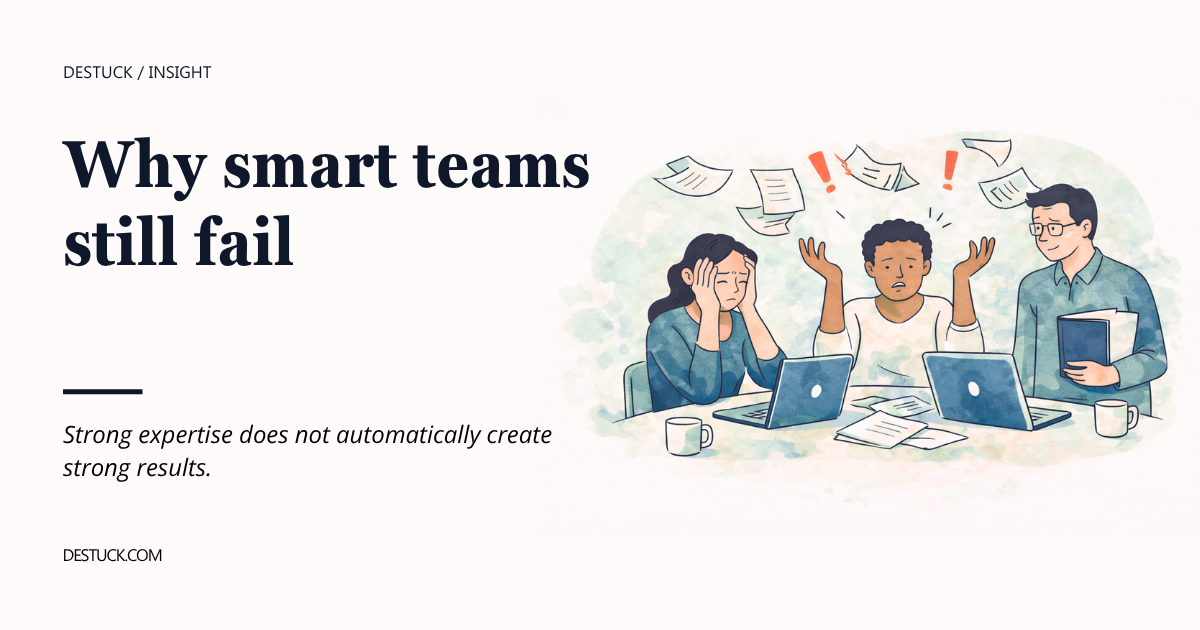
The thing that connects all of these situations is that the problem was never the people. It was the structural conditions they were operating inside. And the structural conditions are almost always invisible to the people inside them.
That's what makes this so persistent. A manager looking at a team that's underperforming sees the symptoms clearly — slow output, missed deadlines, friction between people, discussions that go nowhere. But the symptoms and the causes almost never sit in the same place. What shows up on the surface is usually a downstream signal of an upstream structural weakness.
A team that appears unmotivated may actually be suffering from weak direction. A team that seems disorganized may be dealing with broken systems. A team that can't convert discussion into action may lack decisiveness. Without a structural lens, a manager is left making educated guesses. And educated guesses, applied repeatedly without a map, are how teams end up in cycles of intervention that never quite solve anything.
This is what I keep coming back to. Once you start seeing team performance as a system — not a collection of individual behaviors, but a set of interacting structural conditions — the whole picture changes.
The question stops being "who is the problem?" and becomes "what are the structural conditions this team is working inside?" That's a harder question. It doesn't have a satisfying single answer. But it's the right question, because it points toward interventions that actually change outcomes instead of just reshuffling the same frustrations.
A team might have strong expertise and motivation, and still struggle — because direction is weak, the environment is fragmented, or the ability to move from decision to action is inconsistent. The issue isn't talent. It's the structure through which that talent is expected to operate. And once you can see the structure, you stop blaming the people inside it and start fixing the conditions around them.
The Destuck diagnostic maps twelve structural dimensions of how your team actually works — and shows which patterns are driving what you're seeing on the surface.
Take the diagnosticNot sure what to write? Grab a ready-to-use post.