
Signs your team is dysfunctional
Most dysfunction is not dramatic. It is quiet, cumulative, and easy to misread.
Team dysfunction rarely announces itself. There is no single catastrophic meeting, no dramatic blowup. Instead, it accumulates — small frictions, recurring slowdowns, quiet erosions of trust that each seem manageable on their own but together indicate something structural is off.
The difficulty is that dysfunction usually doesn't look like dysfunction from the inside. It looks like a hard quarter, a complex project, or people who need to communicate better. Managers often spend months applying individual-level fixes to what are actually team-level, structural problems — and wonder why nothing sticks.
What "dysfunctional" actually means
The word gets used loosely. People call a team dysfunctional when there's conflict, when someone is underperforming, or when morale is visibly low. But those are symptoms, not the condition itself.
A team is dysfunctional when its structural conditions prevent it from reliably converting effort into results. The people may be capable. The strategy may be sound. But somewhere in the system — in how direction is set, how work gets coordinated, how decisions get made, how feedback flows — something is broken.
J. Richard Hackman's research at Harvard, which studied over 120 teams across industries, found that team effectiveness depends far more on structural conditions than on the talent of individual members. His conclusion: get the conditions right, and even an average group outperforms a talented group with poor structure. This changes what you look for. Not a bad actor or a poor performer — a structural condition that is quietly weakening the team as a system.
Six signs — and what each one is actually telling you
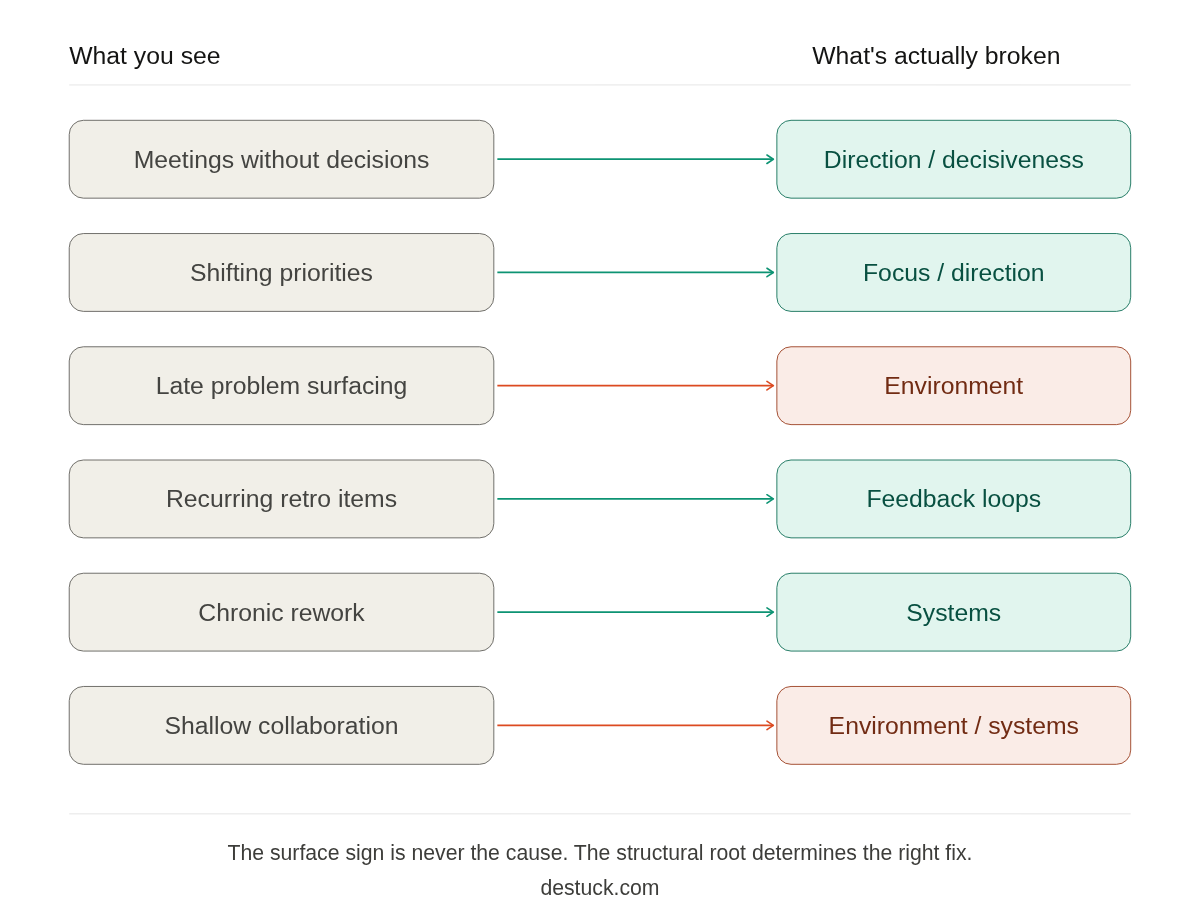
Each pattern below is a surface signal. What matters more is what it points to structurally — because that determines whether the right fix is a process change, an environment shift, a direction reset, or something else entirely.
Meetings multiply, but decisions don't
The team meets often. Topics get discussed, positions get aired, time passes. But the number of real, acted-upon decisions per week is low. Conversations circle back to the same open questions.
What it usually points to: A direction or decisiveness failure. The team either lacks shared clarity on what matters most, or it lacks the ability to convert discussion into commitment.
The structural question: Does the team have a clear, stable set of priorities — and does the decision-making process reliably produce commitments that people act on?
Priorities shift faster than work can move
There is always something urgent. What was important last week is not important this week. People learn not to invest too deeply in any one thing. The system keeps pulling attention away from completion.
What it usually points to: A focus or direction failure. The team does not have a mechanism for protecting priorities from interruption.
The structural question: How many active priorities does the team have right now — and how many can it realistically handle at once?
Recognizing these signs in your team?
The Destuck diagnostic maps which structural dimensions are under strain — so you know what to fix, not just what to notice.
Take the diagnostic
People stop flagging problems early
In a healthy team, problems surface early, when they are small. In a dysfunctional one, problems surface late — often when they've already become expensive. This is almost never a communication failure. It's usually a signal that something about the environment makes early honesty feel risky.
What it usually points to: An environment failure — whether the team's conditions make it safe to surface bad news before it becomes a crisis.
The structural question: What happened the last time someone raised a problem early? Was it received as helpful or treated as unwelcome?
The same issues reappear in every retrospective
If your team runs any kind of retrospective and the items on the list look familiar, the team is treating symptoms rather than causes. The retro identifies the problem. The team agrees to fix it. Then nothing structurally changes.
What it usually points to: A feedback loop failure. The team observes problems but the mechanism for resolving them is not functional.
The structural question: Does the team have a working mechanism for turning observed problems into structural changes — or only a mechanism for discussing them?
Work arrives finished but needs to be redone
Rework is expensive in time, morale, and trust. Chronic rework teaches people that "done" doesn't really mean done — which erodes ownership and lowers standards across the board.
What it usually points to: A systems failure — unclear expectations, missing checkpoints, or feedback that arrives after the work is complete instead of while it's in progress.
The structural question: At what point does the person doing the work learn whether they're on the right track — before or after they've finished?
Collaboration looks fine, but integration is shallow
On the surface, people are collegial. No visible conflict. But when you look at how work actually gets coordinated — handoffs, dependencies, building on each other's output — the integration is thin. People are working next to each other, not with each other.
What it usually points to: An environment or systems problem. The conditions for genuine coordination are absent, even when the interpersonal relationships are fine.
The structural question: Does the team have structured moments where people's work actually connects — or does each person operate in a parallel track?
Why these signs get misread
There is a predictable error in how managers interpret these signals. Because the signs involve people — meetings people run, decisions people avoid, problems people don't raise — the natural assumption is that people are the cause.
But more often, the people are responding rationally to a broken system. They avoid raising problems because past warnings were dismissed. They stop investing in priorities because priorities have changed too many times. They produce shallow collaboration because the structural conditions for deep coordination don't exist.
When managers apply people-level fixes to structural problems, they create churn without creating improvement. The signs recur. The team gradually stops believing that real change is possible.
Quick reference: signs and structural roots
Recognizing the sign is the starting point
Knowing that your team shows these signs is useful — but it is not sufficient. The harder question is which structural dimension is actually failing, how severely, and in combination with what else. Two teams can show identical surface signals and be dealing with entirely different underlying conditions.
That is why the response needs to be diagnostic, not prescriptive. A generic intervention applied to a misidentified cause does not fix dysfunction — it delays it, and often adds to it.
The Destuck diagnostic maps twelve structural dimensions of how your team actually works — and shows which patterns are driving what you're seeing on the surface.
Take the diagnosticNot sure what to write? Grab a ready-to-use post.