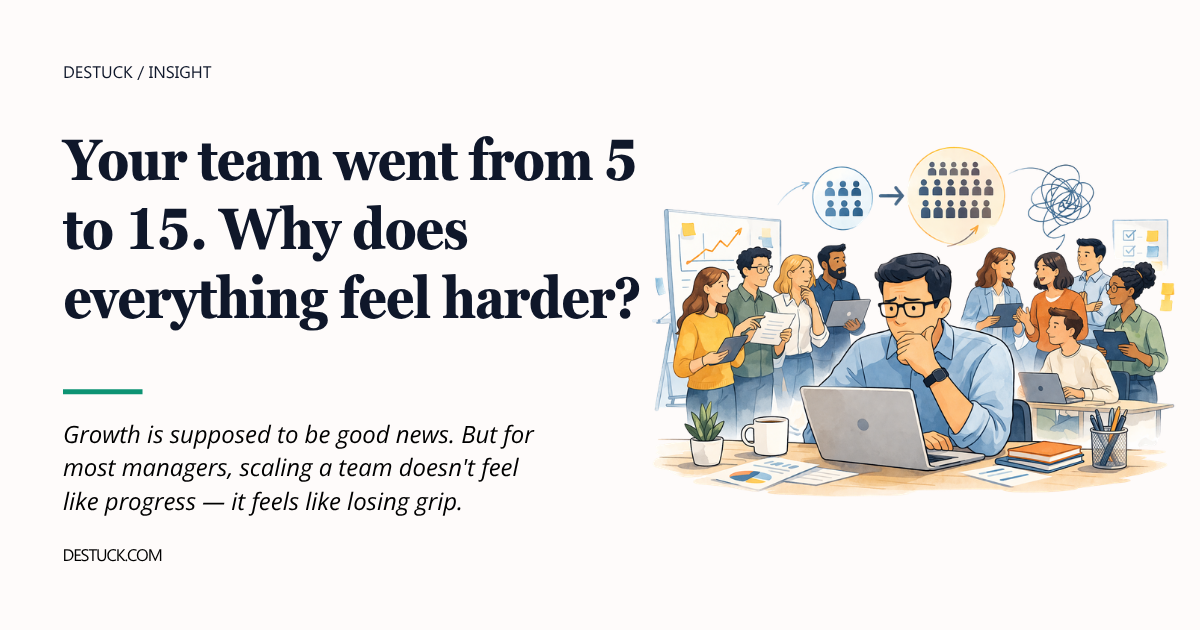
Your team went from 5 to 15. Why does everything feel harder?
Growth is supposed to be good news. But for most managers, scaling a team doesn't feel like progress — it feels like losing grip.
You managed five people and it worked. You knew what everyone was doing. Decisions happened in hallway conversations or a quick Slack thread. If something went sideways, you could see it and course-correct the same day. Direction didn't need to be written down because everyone heard you say it.
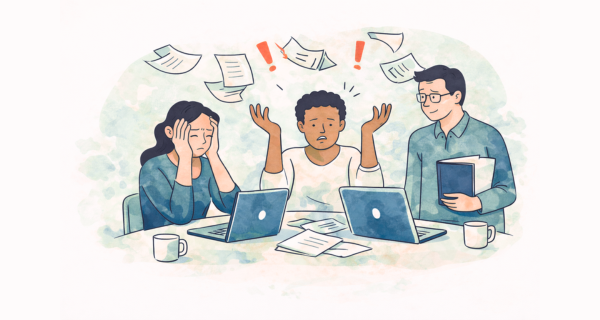
Then the team grew. Maybe it was gradual — a hire here, a transfer there. Maybe leadership expanded your scope overnight. Either way, fifteen people now report to you, and everything that used to feel effortless now feels like it's dragging. You're working harder than you've ever worked, and somehow the team is producing less clarity, not more.
The structure was always there — you just couldn't see it
Here's what most managers miss about small teams: they have structure. It just doesn't look like structure. At five people, direction is maintained through proximity — everyone is close enough to the source of decisions that alignment happens almost by osmosis. Systems are informal but effective because every handoff is a direct conversation. The environment feels safe because everyone knows each other well enough to speak freely.
None of this is documented. None of it is deliberate. And that's precisely the problem — because when the team grows, the manager tries to scale the approach instead of recognizing that the approach itself was a product of a size that no longer exists.
Hackman's research on what makes teams effective consistently found that structural conditions — clear direction, enabling systems, a supportive environment — determine team outcomes far more than individual talent does. At small scale, these conditions can exist informally. At larger scale, they either become explicit or they collapse.
It's not a linear problem
The instinct is to think of scaling as a volume challenge: more people means more of what you were already doing. More check-ins. More status updates. More time in meetings. More messages in the group chat. Managers who scale this way end up exhausted and confused — they're doing everything they did before, just more of it, and it's working less.
That's because the transition from a small team to a mid-size team isn't a linear increase in complexity. It's a phase change. The mechanisms that held the small team together don't just weaken at scale — they stop functioning entirely, and the manager often doesn't realize it because the symptoms look like people problems.
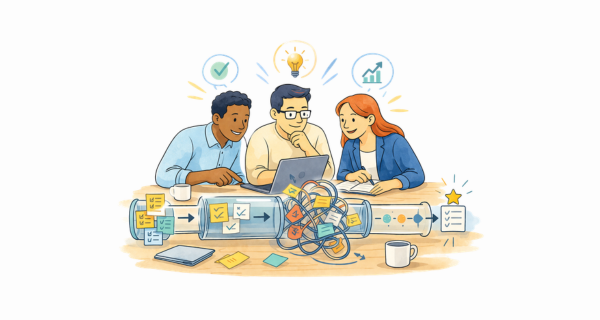
Communication that used to flow directly now passes through layers. Shared context that used to be automatic now has gaps nobody notices until something breaks. Decisions that used to be made by walking over to someone's desk now require coordination that doesn't have a process yet. The team hasn't gotten worse. The structure that made it work was never built for this size — and nobody built a new one.
Three things that quietly break
In almost every team I've seen struggle with this transition, the same three structural dimensions are involved.
Direction becomes ambiguous. At five, the manager could communicate strategic intent once and everyone carried it. At fifteen, the same message gets interpreted differently by different subgroups. Without repeated, explicit articulation of where the team is going and why, people start making reasonable but divergent assumptions. The team feels busy but misaligned — not because anyone disagrees, but because nobody is working from the same understanding anymore.
Systems stay informal past their expiration date. The handoff process that worked when two people sat next to each other doesn't work when six people are involved across time zones. The decision-making rhythm that was organic at five becomes invisible at fifteen — not absent, just unclear. Who decides what, and by when? In a small team, everyone knew. In a mid-size team, everyone assumes someone else knows.
The environment shifts without warning. Psychological safety is partly a function of familiarity. At five, people knew each other well enough to be direct. At fifteen, there are newer members who haven't built that trust, and the original dynamic is diluted. Edmondson's research found that team environments don't maintain themselves automatically — they require deliberate reinforcement. What the manager experiences as "the culture has changed" is often the environment responding predictably to a structural shift that was never addressed.
Your team grew — and something shifted.
The Destuck diagnostic maps twelve structural dimensions — including the ones that break first when teams scale past the size where informal conditions stop working.
Take the diagnosticThe manager's job changed — and nobody said so
This is the part that catches managers off guard. At five people, the job was to lead the work. To be close enough to every project that you could steer by instinct. At fifteen, that's no longer possible — and if you try, you become the bottleneck.
The job at scale is different: it's to build and maintain the structural conditions that let the team work without you being involved in every decision. Direction has to be articulated clearly enough that people three conversations removed from you still understand it. Systems have to be explicit enough that handoffs happen without you brokering them. The environment has to be reinforced deliberately because the trust that was automatic at small scale is now something that needs cultivation.
Most managers experience the scaling transition as a personal failure — they feel less effective, less connected, less in control. It's not a personal failure. It's a structural one. The conditions that need to exist at fifteen are fundamentally different from the ones that existed at five, and the manager hasn't been told that, let alone shown what the new conditions look like.
Before you add process, understand the structure
The usual response to scaling pain is to add process. New meeting rhythms. New reporting structures. New tools. This sometimes helps, but it often makes things worse — because it addresses symptoms without understanding which structural conditions are actually under strain.
Adding a weekly status meeting doesn't fix ambiguous direction — it just makes the ambiguity more visible. Implementing a project management tool doesn't fix unclear ownership — it just moves the confusion into a different format. Argyris's work on organizational learning showed that most process additions in teams function as defensive routines — they address the surface tension without touching the underlying structural condition.
The more useful question isn't "what process should we add?" It's "which structural conditions need to exist at this size that didn't need to exist before?" That's a diagnostic question, not a process question. And the answer is different for every team — because the specific dimensions under strain depend on what the team was relying on informally that no longer holds.
The Destuck diagnostic maps twelve structural dimensions of how your team actually works — and shows which ones need to become explicit before growth turns manageable tension into visible breakdown.
Take the diagnosticNot sure what to write? Grab a ready-to-use post.