Why team morale is fine but output is low
When your team feels engaged but the results don't match, the problem isn't motivation. It's what sits between effort and output.
This is one of the most confusing situations a manager can face. The team seems fine. People show up engaged. They contribute in meetings, volunteer for projects, care about the work. If you asked them directly, they'd say things are going well. And yet the output doesn't reflect any of that. Deadlines slip. Deliverables come in late or half-finished. The results feel like they belong to a different team than the one you see every day.
The instinct is to question the morale reading. Maybe they're not as engaged as they seem. Maybe it's quiet disengagement — people going through the motions. But often, the morale reading is accurate. People genuinely care. The problem is that their effort is being absorbed by something between intention and output — and that something is structural.
The gap between effort and results
There's an assumption baked into most management thinking: if people are motivated and capable, results should follow. Effort in, output out. And when it doesn't work that way, the default explanation is that the effort must be the problem — either it's not enough, or it's not the right kind.
But Hackman's research on team conditions found something different. Team performance depends less on individual motivation than on the structural conditions surrounding the team — clear direction, enabling systems, sufficient resources. A highly motivated team working inside broken systems will produce results that look like a motivation problem. The effort enters the system. The system wastes it. And the manager sees low output and looks for the wrong cause.
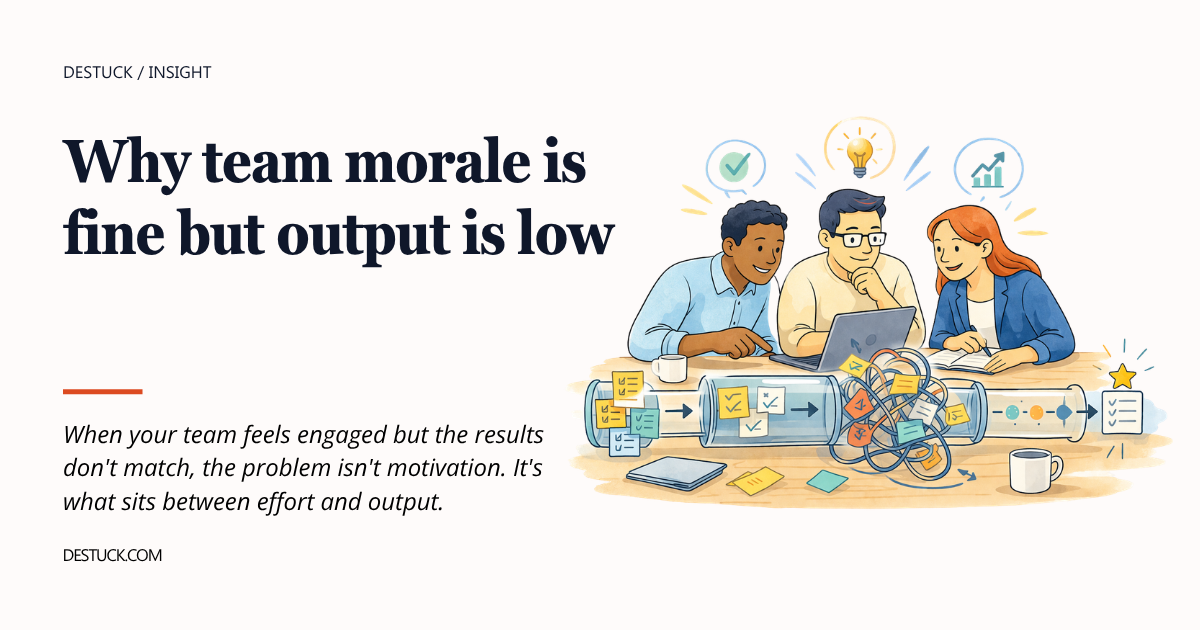
This is the pattern: the team has energy but no reliable channel for that energy. People are busy. They're working hard. But the infrastructure that's supposed to convert their effort into delivered results has friction in it — handoff gaps, unclear priorities, rework loops, decisions that don't stick. The energy isn't missing. It's leaking.
What busyness conceals
One of the reasons this pattern persists undiagnosed is that the team looks productive. People are in meetings. Work is happening. There's visible activity — and activity feels like progress.
But activity and output are not the same thing. A team can spend most of its week on work that doesn't move the needle — status updates that don't lead to decisions, planning sessions that produce plans nobody follows, rework caused by misaligned expectations that were never surfaced early enough. Google's Project Aristotle research found that the highest-performing teams weren't defined by how hard they worked, but by how effectively their work translated into outcomes. Translation efficiency, not effort volume, was the differentiator.
When morale is fine but output is low, this is usually the mechanism. The team isn't underworking. It's overworking on the wrong things, or reworking the right things because the system didn't route them cleanly the first time.
Your team feels fine. The output doesn't.
The Destuck diagnostic maps exactly where effort is being absorbed before it reaches results — across twelve structural dimensions.
Take the diagnosticThree structural patterns that produce this mismatch
In my experience, the morale-is-fine-but-output-is-low situation almost always traces to one of three structural conditions — or a combination of them.
The priority fog. The team has too many things in flight and no clear signal about which ones matter most. People are working hard — on different things. Effort is spread across competing priorities, and nothing gets enough concentrated attention to ship well. Morale stays intact because everyone feels productive. Output stays low because the work never converges.
The rework loop. Work gets done, but doesn't stick. Deliverables come back for revision. Decisions get revisited. Expectations shift after the work is already underway. Chris Argyris described this kind of dynamic as a defensive routine — an organizational pattern that protects against discomfort by avoiding the conversation that would have prevented the problem. The team does the work, discovers it was wrong, and does it again. Twice the effort, same output.
The system gap. There's no reliable infrastructure for how work moves from one person or stage to the next. Handoffs are informal. Status lives in people's heads. Coordination depends on individual relationships rather than clear processes. People compensate for the system's gaps with personal effort — and that effort is invisible on any output metric because it's spent on keeping things from falling apart, not on delivering results.
Why the usual fixes don't work here
When output is low, the standard playbook is to push harder. Set tighter deadlines. Add accountability mechanisms. Hire more people. Run a motivation workshop.
None of these solve a structural problem. Tighter deadlines on a team that's already working hard just compresses the same amount of friction into less time. Accountability mechanisms create consequences for outcomes that are being caused by system design, not by effort. Hiring more people adds capacity to a system that's already leaking — the new hires will experience the same friction. And a motivation workshop for a team that's already motivated is, at best, irrelevant.
The dangerous thing about this pattern is that each failed fix reinforces the wrong narrative. We tried accountability and it didn't work — so the team must be the problem. We hired more people and output barely changed — so the people must not be good enough. The structural cause stays invisible because every intervention is aimed at the people layer, and the people layer isn't where the problem lives.
What to look for instead
If morale is genuinely fine and output is genuinely low, the most productive thing you can do is stop looking at the people and start looking at the path the work takes.
Map what happens between the moment someone starts a task and the moment a result lands. How many times does the work change hands? How often does direction shift midstream? How much time goes to coordination versus creation? Where are the bottlenecks — and are they process bottlenecks or decision bottlenecks?
Edmondson's research on psychological safety points to one more dimension: even on teams where people feel safe enough to be engaged, they may not feel safe enough to flag that the system isn't working. Morale can coexist with silence. The team is motivated and committed — but nobody says "this process wastes half my week" because the environment doesn't reward that kind of honesty. So the structural issue persists, invisible, while everyone works hard inside it.
The Destuck diagnostic separates effort from output — showing which structural dimensions are absorbing your team's energy before it reaches results.
Take the diagnosticNot sure what to write? Grab a ready-to-use post.